

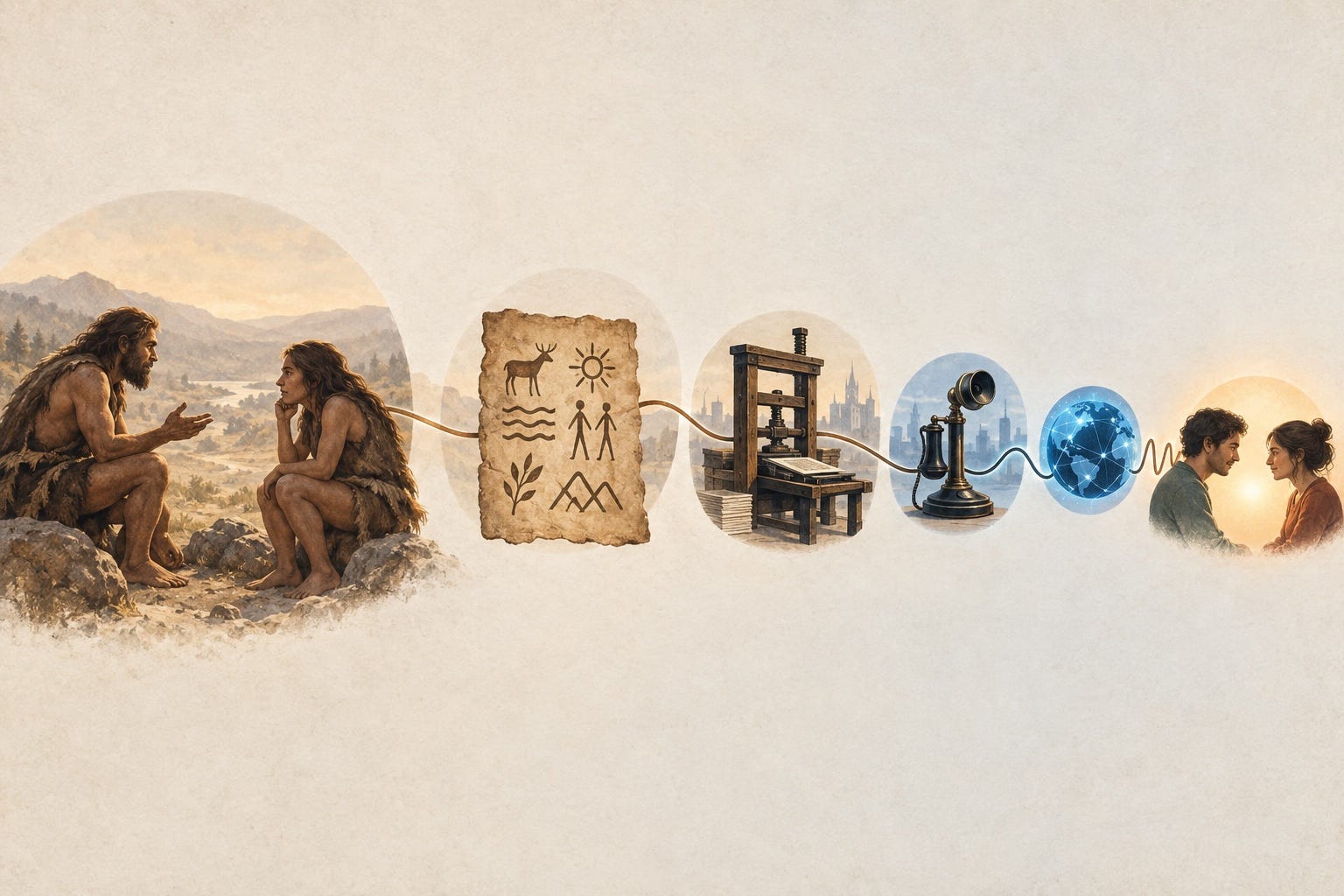
If we look through history we notice that progress is often marked by advances in communication.
First there was language itself. At some point humans developed the ability to create and communicate complex thoughts and ideas using words and sentences. It opened up completely new ways of living and working together.
Then there was written language, which allowed us to record and transmit information beyond our physical presence. Knowledge no longer had to disappear when the person who knew it died.
Next came the printing press, which allowed the same ideas to be spread to thousands and eventually millions of people.
Then came the telephone, radio, film and television. And more recently, of course, the internet.
But in addition to allowing us to communicate more widely and effectively, all these advances have brought one other benefit: speed.
We not only communicate more. We communicate faster.
And we can see this accelerating today.
We can watch a video at double speed, effectively halving the time we need to spend getting the same information. We can read an automatically generated transcript of a video so we can scan the information rather than watching it all the way through. We can ask AI to summarise a video or even a whole book for us.
And in putting out our own communication we can compress time massively as well. We can speak and have our words turned into text automatically. We can record a video on our phone and instantly share it with thousands of people around the world.
All of this has made communication faster and faster.
It has literally compressed time.
But where could this lead?
What could be the next development in compressing communication time?
We are already getting close to the point where there isn’t much more time to remove. I can send you a message from the other side of the world and you can receive it almost instantly.
But there is still one part of the process that takes time:
The words themselves.
No matter how quickly a message reaches you, you still have to read or listen to the words and work out what they mean.
And sometimes that takes a lot of words.
So perhaps the next development in communication isn’t making words travel even faster.
Perhaps it is needing fewer words in the first place.
Or even none at all.
What would that look like?
How about communicating directly to others without the use of words or thoughts at all?
Others would know, if you wanted them to, how you wanted them to feel or what you wanted them to know. They wouldn’t need to wait to hear your words. They wouldn’t need to try to understand or interpret what it was that you said.
They would just know.
Instantly and automatically.
Now you might think this is a crazy idea. After all, if you can’t use words to communicate, what else is there?
But think about this.
Have you ever had the experience of just knowing something that you couldn’t put into words?
Think about looking at a puppy or a young child. Holding the one you love in a gentle hug. Or even just remembering a moment or experience that brought you pleasure.
These are some of life’s most profound moments.
Yet none of them need words.
You might try to describe the feeling, but you’re always left short, aren’t you? Eventually you come to the conclusion that “words can’t describe” that experience or feeling.
And there are other examples.
Have you ever known how someone was feeling before they said anything?
Have you ever walked into a room and sensed immediately that something wasn’t right?
Have you ever looked at someone you know well and somehow known what they were thinking or feeling without either of you saying a word?
There is nothing particularly mysterious about any of this. Humans have always communicated in ways that don’t involve words. We use facial expressions, gestures, touch, sounds and all sorts of other signals that we often aren’t even consciously aware of.
Language added another remarkable way of communicating. It allowed us to turn what was happening inside us into words and pass those words to someone else.
But words also added an extra step:
I have to turn what I mean into words.
And you have to turn my words back into what I mean.
No matter how fast technology makes communication, that step is still there.
So perhaps the next great development in communication won’t come from another technology that allows us to send words even faster.
Perhaps it will come from developing the ways we already communicate without them.
And there is something particularly interesting about this possibility right now.
AI is rapidly becoming extremely good at working with words. It can write them, interpret them, translate them, summarise them and rearrange them. It can do in seconds things that might take us hours.
So perhaps, strangely enough, AI will cause us to look in the other direction.
Words and language have their place. They can be extremely useful.
But maybe we have become so dependent on them that we have overlooked something else.
Perhaps there is a level of communication beyond words that we can naturally tap into.
And perhaps, in a world where machines become increasingly good at using words and thinking, one of the greatest human skills waiting to be rediscovered is what we can do without them.
That would be an interesting development.
This also raises a much bigger question.
If language changed the way humans communicate, what else did it change?
That is a question I have been exploring for some time. Because I think language didn’t just give us a new way to communicate with each other. It gave us a new way to communicate with ourselves.
And that may have changed far more than we realise.
If you’d like to explore these ideas further, or find out more about my work and ways you can engage with me personally, visit liamnaden.com.